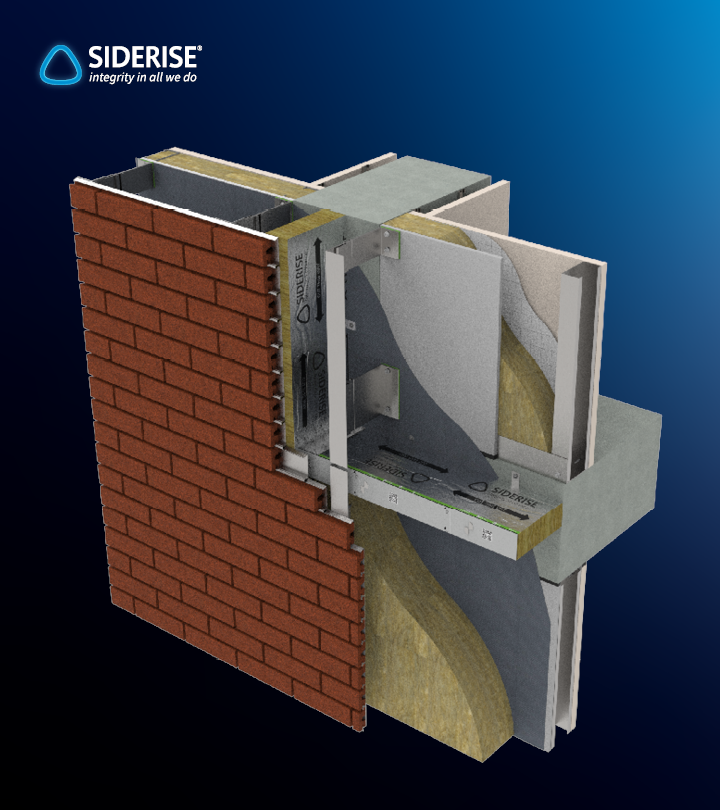
Brick Slip Cavity Barriers
Tested within ventilated brick-slip cladding systems the Siderise Brick Slip Cavity Barriers comprise of the Siderise RH open state cavity barrier, in the horizontal orientation, and the Siderise RV cavity barrier, in the vertical orientation. Their combined use ensures that the brick slip system will drain moisture within the façade construction whilst maintaining airflow in normal service.
Siderise RH Open State horizontal cavity barriers incorporate a continuous high performance reactive intumescent strip which is bonded to the leading edge. In the event of fire, the intumescent rapidly expands and fully seals the purposely designed ventilation gap, between the barrier and the rear of the cladding, formed at the time of installation. RH is compliant with current market requirements and has been tested to ASFP Guidance: ’Open State’ Cavity Barriers used in External Envelope or Fabric of Buildings, utilising principles of EN 1363-1, referred to as ASFP Technical Guidance Document –TGD 19 (EN 1364-6).
Siderise RV vertical cavity barriers for cladding are used to full fill the void between the external envelope and internal structure. For instance, when used in a mechanically fixed brick slip cladding system, RV is installed tightly compressed to the external horizontal rails and allowed to expand through rail gap. This is facilitated by cutting along the top and bottom of the barrier’s intersection with the rails. This in turn allows the stone wool in the RV barriers to expand back out and fill the gaps that may be created by the brick-slip rails.
Where Brick slip frogs are present, Siderise FR-X Fire Rated Wet Zone Sealant can be further applied into the frogs that align with the RV barriers. Please refer to the specific installation instructions provided for your specific brick slip system or contact our Technical Services Team.
The unique stone wool lamella core construction of Siderise RV enables the vertical barriers to accommodate the serviceability movement normally associated with cladding façade systems. Intersections between the horizontal and vertical cavity barriers are simply abutted, with RFT 120/45 foil tape applied as detailed in installation instructions provided separately.
Siderise RH ‘Open State’ horizontal cavity barriers for brick slip systems consist of a non-combustible stone wool lamella core, with reinforced aluminium foil faces. The primary seal has a reaction to fire performance of Class 'A1' to BS EN 13501-1:2018, while the continuous intumescent strip on the exposed edge has a reaction to fire performance of Class ‘E’ to EN 13501-1 enabling it to react rapidly and close the purposely designed ventilation gap in the event of fire. This is permitted by Regulation 7(3)(f) - Approved Document B for England & Wales.
The exposed leading edge is also sealed with aluminium foil & additionally encapsulated in a polymer film. As standard, the film is black to register as a ‘shadow-line’ behind open joints in the cladding.
Whilst the base material is water repellent and non-hygroscopic, this predominantly enclosed arrangement affords an added degree of weather protection to the core material. It is designed to leave an air gap for moisture drainage and allow ventilation in the brick slip cladding system but provide a seal in the event of a fire. For product identification purposes, the top edges of the film used on the RH cavity barriers are colour-coded and labelled to show the product fire performance rating. Please see Table 1.
Siderise RV vertical cavity barriers for brick slip systems consist of a non-combustible stone wool lamella core, with reinforced aluminium foil faces. Siderise RV vertical cavity barriers are installed within the cavity formed between the Brick slip facade and the inner structural wall using appropriate Siderise support brackets. Brackets are available in either galvanised mild steel (G) or stainless steel (S).
The standard product length for both horizontal and vertical cavity barriers is 1200mm. Whereas horizontal barriers are only available as precut strips, vertical barriers are also available in sheet form.
Brick Slip Systems / Project Level Testing
Brick slip systems typically contain a series of rails to support the outer brick slips. These brick slips can also incorporate voids or ‘frogs’ within them. It is important that even if specifying facades under the ‘linear route’ within Approved Document B, that consideration is given to the hidden voids created by these rails and brick slip ‘frogs’. Therefore, we recommend partnering with us to test specific systems at our Innovation Centre. These project level test reports can then be used as supporting evidence by the project fire engineer and design team.
It may be the case that our existing test library provides support for a given project arrangement, please consult our standards details and engage with our Technical Services team for clarification.
Reaction to fire
This is the response of a material in contributing by its own decomposition to a fire to which it is exposed under specified conditions. Results are classified to BS EN 13501-1:2018 “Fire classification of construction products and building elements”. The primary element of the seal (stone wool with aluminium foil facings) used in Siderise RH horizontal cavity barriers have a reaction to fire Third-party certification with Intertek and are classified as ‘A1’ to EN 13501-1. The intumescent has a reaction to fire classification of ‘E’ to EN 13501-1 enabling it to react rapidly and close the purposely designed ventilation gap in the event of fire. This is permitted by Regulation 7(3)(f) - Approved Document B for England & Wales. Siderise RV vertical cavity barriers have reaction to fire Third-party certification with Intertek and are classified as ‘A1’ to EN 13501-1.
Resistance to Fire
This is the ability of an element of structure or product to maintain its stability for a specific time period as determined by ‘integrity’ (E) and ‘insulation’ (I) as specified in the fire resistance test. Where appropriate results can then be classified in accordance with EN 13501-2. Siderise has tested RH horizontal cavity barriers with a 25mm air gap to the ASFP TGD19 method. During the fire tests, the seals achieved full effective closure in under 5 minutes. Seal temperatures remained below a 180°C rise during this activation period and maintained the EI requirements for up to E 120 and I 120. See Table 1 for details. Siderise RV vertical cavity barriers have been tested for resistance to fire in accordance with BS EN 1366-4: 2006+A1: 2010. The cavity barriers maintained integrity (E) and insulation (I) requirements as detailed in Tables below.
Please note: the fire resistance performance for RH and RV cavity barriers given in tables 1 and 3 relate to the performance of barrier in isolation, the overall performance of the system should be reviewed by Technical Services, with additional project level test evidence provided via the Siderise Innovation Centre if necessary. Please see below tables for product fire performance ratings and applicable void sizes.
Table 1 : RH Fire Resistance to General Principles of ASFP - TGD 19 (EN 1364-6)
| Product Ref | Colour | Max Air Gap (mm) | Integrity (mins) | Insulation (mins) | Barrier Thickness (mm) | Max Void (mm) | Third-party Certification |
|---|---|---|---|---|---|---|---|
|
RH25-120/90 |
Grey |
25 |
120 |
90 |
Intumescent strip (1.5) |
25 |
IFCC 1712 |
|
RH25-90/30 |
Green |
25 |
90 |
30 |
75 |
425 |
IFCC 1712 |
|
RH25-60/60 |
Orange |
25 |
60 |
60 |
90 |
425 |
IFCC 1712 |
|
RH25-120/120* |
White |
25 |
120 |
120 |
120 |
425 |
IFCC 1712 |
|
RH50-60/60 |
Blue |
50 |
60 |
60 |
Intumescent strip (3.0) |
50 |
IFCC 1712 |
|
RH50-30/30 |
Red |
50 |
30 |
30 |
75 |
300 |
IFCC 1712 |
|
RH50-60/60 |
Blue |
50 |
60 |
60 |
90 |
300 |
IFCC 1712 |
* Tested with min. 50mm thick stone wool thermal insulation (classified A1 to EN 13501-1) above and below the cavity barrier. See IFC Certification IFCC 1712 for further details.
Table 2: RH Fixing requirements and barrier dimensions
| Product Range | Void Range (mm) | Air Gap (mm) | Barrier Width (mm) | Length (mm) | Fixings |
|---|---|---|---|---|---|
|
RH25 |
≤ 25 |
≤ 25 |
Intumescent strip (1.5) |
1200 |
3no. Screws |
|
26 - 40 |
≤ 25 |
15 |
1200 |
3no. Screws |
|
|
41 - 45 |
≤ 25 |
20 |
1200 |
3no. Screws |
|
|
46 - 75 |
≤ 25 |
Void - 25 |
1200 |
3no. Screws |
|
|
76 - 250 |
≤ 25 |
Void - 25 |
1200 |
3no. RS 350 G/S |
|
|
251 - 350 |
≤ 25 |
Void - 25 |
1200 |
3no. RS 450 G/S |
|
|
351 - 400 |
≤ 25 |
Void - 25 |
1200 |
3no. RS 550 G/S |
|
|
RH50 |
≤ 50 |
≤ 50 |
Intumescent strip (3.0) |
1200 |
3no. Screws |
|
51-65 |
≤ 50 |
15 |
1200 |
3no. Screws |
|
|
66 - 70 |
≤ 50 |
20 |
1200 |
3no. Screws |
|
|
71 - 100 |
≤ 50 |
Void - 50 |
1200 |
3no. Screws |
|
|
101 - 250 |
≤ 50 |
Void - 50 |
1200 |
3no. RS 350 G/S |
|
|
251 - 300 |
≤ 50 |
Void - 50 |
1200 |
3no. RS 450 G/S |
Please note:
- Brackets are available in two forms: (G) denotes galvanised steel brackets and (S) denotes stainless steel brackets.
- Brackets must be installed at 400mm centres based on a 1200mm strip. For lengths ≤800mm 2no brackets must be used, with spacing reduced pro-rata. Lengths <100mm should be avoided by cutting down the adjacent barrier accordingly.
- All brackets are to be suitably fixed to the substrate with non-combustible fixings.
- All brackets penetrate the product at mid-thickness. The protruding split ends should be counter-folded to retain the product, except for RH50-60/60 and RH25-120/120. For RH50-60/60, ensure the split end facing down overlaps with the intumescent face. For RH25-120/120, the bracket should overhang the barrier by 15mm then one of the split ends should be bent upwards and the other trimmed flush with the leading face of the barrier.
- Please refer to separate RV-RH installation instructions.
Table 3: RV Vertical Cavity Barriers Resistance to Fire Performance to BS EN 1366-4:2006+A1:2010
| Product Ref | Void Width (mm) | Thickness (mm) | Compression (min.) | Integrity (Mins) | Insulation (mins) | Product Length (mm) | Bracket Requirement | Third-party Certification |
|---|---|---|---|---|---|---|---|---|
|
RV-90/30 |
20 - 50 |
75 |
+10% |
90 |
30 |
1200 |
None. |
IFCC 1712 |
|
51 - 150 |
75 |
+10mm |
90 |
30 |
1200 |
2no.B65/110 600mm centres |
IFCC 1712 |
|
|
151 - 250 |
75 |
+10mm |
90 |
30 |
1200 |
2no.B195 600mm centres |
IFCC 1712 |
|
|
RV-90/30X |
251 - 400 |
90 |
+10mm |
90 |
30 |
1200 |
2no.B355 600mm centres |
IFCC 1712 |
|
RV-90/60 |
20 - 50 |
100 |
+10% |
90 |
60 |
1200 |
None. |
IFCC 1712 |
|
51 - 150 |
100 |
+10mm |
90 |
60 |
1200 |
2no.B65/110 600mm centres |
IFCC 1712 |
|
|
151 - 250 |
100 |
+10mm |
90 |
60 |
1200 |
2no.B195 600mm centres |
IFCC 1712 |
|
|
RV-90/60X |
251 - 400 |
120 |
+10mm |
90 |
60 |
1200 |
2no.B355 600mm centres |
IFCC 1712 |
|
RV-120/120 |
20 - 50 |
120 |
+10% |
120 |
120 |
1200 |
None. |
IFCC 1712 |
|
51 - 150 |
120 |
+10mm |
120 |
120 |
1200 |
2no.B65/110 600mm centres |
IFCC 1712 |
|
|
151 - 250 |
120 |
+10mm |
120 |
120 |
1200 |
2no.B195 600mm centres |
IFCC 1712 |
|
|
RV-120/120X |
251 - 400 |
150 |
+10mm |
120 |
120 |
1200 |
2no.B355 600mm centres |
IFCC 1712 |
Please note: -
Integrity and Insulation ratings in the above tables refer to performance in product fire tests to EN1366-4:2006+A1: 2010.In all cases, we recommend that the specifier and user review the specific project configuration in light of the latest National Building Regulations, local Building Code, and/or government advice.
- The above fire performance relates to product only testing to TGD19, the overall void used within the system should be reviewed by Technical Services and supported by additional system specific project testing if necessary.
- Support brackets should be installed at 600mm fixing centres (300mm from each end).
- The brackets are supplied as standard in 1mm galvanised mild steel (G) or stainless steel (S), in a flat form for site folding.
- Lengths of the barrier are secured with these dedicated brackets, which impale the product at mid thickness to a depth of 75% of void.
- The brackets are to be secured to the inner structural wall using non-combustible steel anchors or screws. These fixings are not supplied by Siderise.
Please refer to separate RV-RH installation instruction.
Table 4: RH Product Properties
| Properties | Value |
|---|---|
| Form Supplied |
1200mm long. Supplied pre-cut in width to suit advised void size reduced by the ventilation gap required. |
| Product Finish |
Aluminium foil tape to top and bottom surfaces |
| Appearance |
Coloured tapes to indicate performance |
| Reaction to Fire |
The primary stone wool seal is Classified 'A1' to EN 13501-1 The reactive intumescent along the leading edge is Class 'E' to EN 13501-1. This is permitted by Regulation 7(3)(f) - Approved Document B for England & Wales. |
| Resistance to Fire |
For product fire performance see Table 1 |
Table 5: RV Product Properties
| Properties | Value |
|---|---|
| Form Supplied |
Sheets : 1200mm x 1200mm; Thickness is denoted by the rating Pre-cut strips: 1200mm long and supplied in width to suit advised void size. |
| Product Finish |
Aluminium foil to surfaces exposed to cavity |
| Product Colour |
Solid, green-brown exposed edges with silver aluminium top and bottom facings |
| Reaction to Fire |
Classified A1 to EN 13501-1 |
| Resistance to Fire |
For product fire performance see Table 3 |
- Stone wool core is recyclable.
The following information is available for download via the website:
- Material Data Sheet
For technical advice or support please contact the technical team: [email protected]
For Installation Training or Site Inspections please contact: [email protected]
The information in this datasheet is believed to be accurate at the date of publication. Siderise has a policy of continuous product improvement and reserves the right to alter or amend the specifications of products without prior notice. Siderise does not accept responsibility for the consequences of using the products described outside of the recommendations within this datasheet. Expert advice should be sought where there is any doubt about the correct specification or installation of Siderise products.