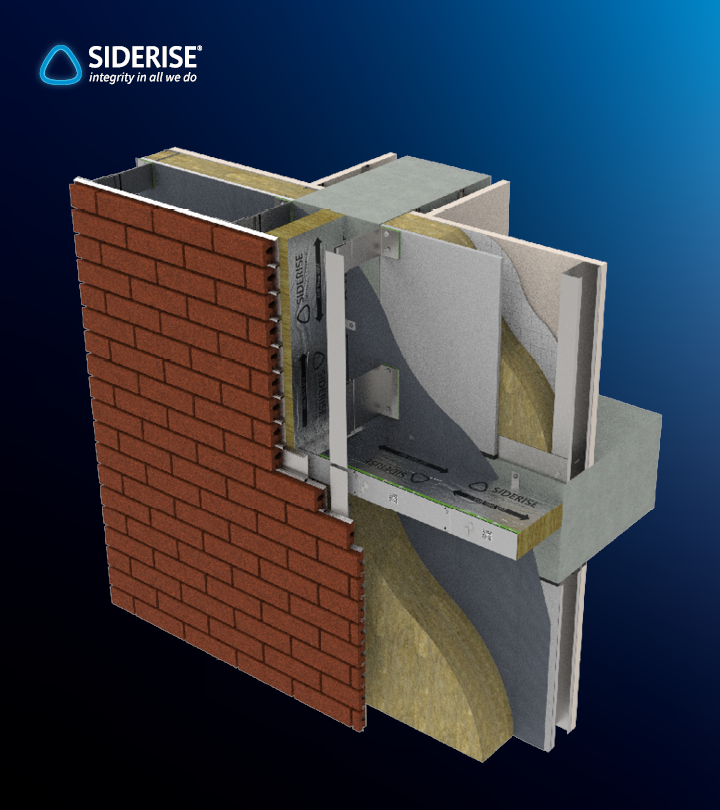
Why T-ratings matter when specifying curtain wall perimeter fire barriers in the UAE

Visit any city in the United Arab Emirates and it is without question that curtain walling is a hugely popular façade choice for high-rise buildings, combining design flexibility and architectural appeal with the performance requirements of modern buildings. When specifying perimeter fire barriers for these projects, a common misinterpretation of the UAE Fire and Life Safety (FLS) Code requirements has resulted in some perimeter fire barrier systems being tested and specified based solely on their F-rating, overlooking the equally important T-rating required for code compliance.
What is the difference between F-ratings and T-ratings?
Under the UAE FLS Code, perimeter fire barriers are generally required to provide a fire resistance rating equivalent to that of the floor assembly, with a minimum rating of one hour depending on the building design. Depending on the fire test standard, classification standard, specification, or authority having jurisdiction (AHJ) fire resistance performance is commonly expressed either as an F rating or an F and T rating, or an E rating or an E and I rating. For the purposes of this blog, we will concentrate on the F and / or T rating as this is what the UAE FLS code specifically calls for:
What is a F-rating?
The F-rating indicates how long a firestop system prevents the physical passage of flames and hot gases through the perimeter barrier and around its intersection with the curtain wall and floor slab, typically expressed in hours.
What is a T-rating?
The T-rating indicates how long the firestop system limits heat transfer through the perimeter barrier. Specifically, it is the time until the temperature on the surface of the barrier that is not exposed to fire rises more than 325°F (181°C) above the ambient temperature. For maximum joint widths greater than 4 in. (102 mm), the average temperature rise as indicated by all unexposed surface thermocouples is more than 250 °F (139 °C) above the initial temperature. This is usually expressed in 15-minute increments and then hours.
While flame spread may be prevented by a system with a satisfactory F-rating, significant heat transfer can still occur through the perimeter joint. If temperatures on the non-fire side become excessive, nearby combustible materials may ignite via conductive heat transfer even though flames have not physically passed through the opening. For instance, synthetic soft furnishings or interior finishes at the wall / floor interface. Therefore, T-ratings provide an important additional measure of real-world fire performance, indicating how effectively a system limits temperature rise and helps reduce the risk of secondary ignition caused by heat transfer. For this reason, specifiers should not assume that a particular F-rating automatically means that a system has achieved an equivalent T-rating.
What do the main curtain wall fire test standards assess?
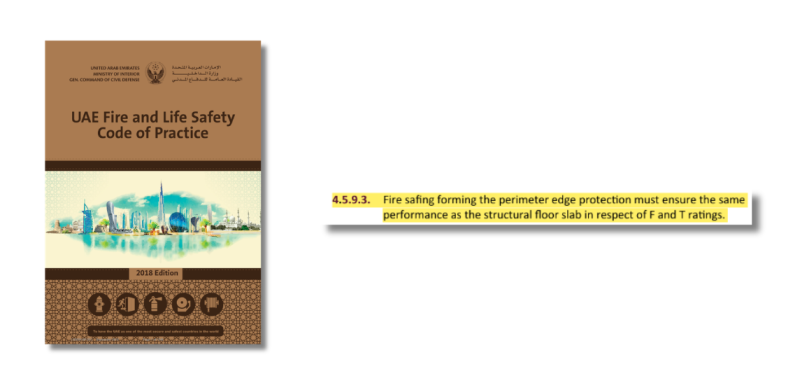
Under the UAE FLS Code, perimeter fire barriers must provide a fire resistance level equal to that of the floor assembly, including both F and T-ratings, stating in clause 4.5.9.3 “Fire safing forming the perimeter edge protection must ensure the same performance as the structural floor slab in respect of F and T ratings.”
EN1364-4
EN 1364-4, Fire resistance tests for non-loadbearing elements – Part 4: Curtain walling – Part configuration, looks at the spandrel assembly of a curtain wall system, comprising the mullions, transoms, and infill and spandrel panels. There are specific configurations of the test that can be chosen depending on the primary element that needs to be assessed. Configuration 5 is used to assess the ability of the perimeter fire seal to contain the fire inside the compartment, under the stress of temperatures and pressures that lead to in-test deflection of the façade and floor slab.
ASTM E2307
ASTM E2307, Standard Test Method for Determining Fire Resistance of Perimeter Fire Barriers Using Intermediate-Scale, Multi-story Test Apparatus, uses intermediate scale multi-storey apparatus to better replicate a fully developed curtain wall fire. The perimeter seal is exposed to fire from both inside and outside the test compartment to simulate the room where the fire started, as the fire plume exits the room of fire origin through a window opening and attempts to leapfrog to the next floor. Like EN 1364-4, it also includes provisions for pre-cycling, or ‘cold’ movement before the test begins, covering thermal load, wind sway, seismic movement, and all these factors combined.
A key but often overlooked point is that whilst ASTM E2307 does ‘define’ evaluation criteria to be met during testing for the system to achieve a T-Rating, it does not ‘mandate’ that the T-rating be equivalent to the F-rating. For instance, a tested system can achieve a T-Rating of just 30 minutes but an F-Rating of 3 hours, and compliance with the standard can be achieved based solely on the system's F-rating. Consequently, as a result of the conditions of compliance with the standard, along with the fact that other codes such as the International Building Code (IBC) do not prescribe a requirement for a T-rating, the F-rating is often regarded as the primary measure of compliance by project teams assuming that that the solution satisfies the UAE FLS Code as it has an ASTM E2307 certification for a suitable number of hours based on the F-rating alone therefore leaving a gap between tested performance and the fire protection objectives established by the Codes.
When reviewing test reports or third-party certification, specifiers should establish exactly what ratings were achieved by the tested system and under what configuration.
Looking at the bigger picture
As scrutiny of fire safety standards continues to increase across the UAE, the industry has an opportunity to move beyond a simple pass-or-fail interpretation of fire tests and focus on the intent of the regulations and a fuller understanding of the evidence available to support product specification.
For curtain wall perimeter fire barriers, this means understanding that preventing flame penetration is only part of what makes a fire resistance solution and limiting heat transfer can be equally important in preventing fire spread and protecting occupants and property. By considering both F- and T-ratings during specification, and by seeking independently verified evidence of performance, specifiers can make more informed decisions that align with the requirements and objectives of the UAE FLS Code
Interested in learning more? Contact our MEIAP technical team at [email protected]
Contact us
We're here to help you
Call for our main switchboard
Email us for technical enquiries
Email us for site support
Complete the form for the right response