Insights from UK Construction Week: Why connection is now critical to construction performance
UK Construction Week London 2026 reinforced its position as the UK’s most influential construction and built environment event bringing together ministers, policymakers and industry leaders to engage directly with the sector on its biggest challenges.
Co-located with Futurebuild and the Stone & Surfaces Show, the event delivered three high-energy days of debate, innovation and collaboration covering housing, infrastructure, planning, skills, retrofit and economic growth. With packed aisles, standing-room-only theatres and high-level networking throughout, it remains unmatched in its ability to bring together government engagement, industry influence and market reach under one roof.
Against this backdrop, UKCW highlighted a sector under increasing pressure to connect across systems, disciplines and information. From façade integration to AI-driven discovery, delivering better buildings increasingly depends on clarity, collaboration and a system-led approach.
This year’s event reflected an industry under pressure to evolve - driven by stricter regulation, increasing technical complexity, advancing AI technologies and a growing demand for demonstrable performance. For Siderise, our presence across two sessions reinforced a clear and consistent message:
“Better buildings depend on better connection - between systems, between disciplines, and between the people designing and delivering them.”
Looking beyond components: a system-led view of external masonry wall design
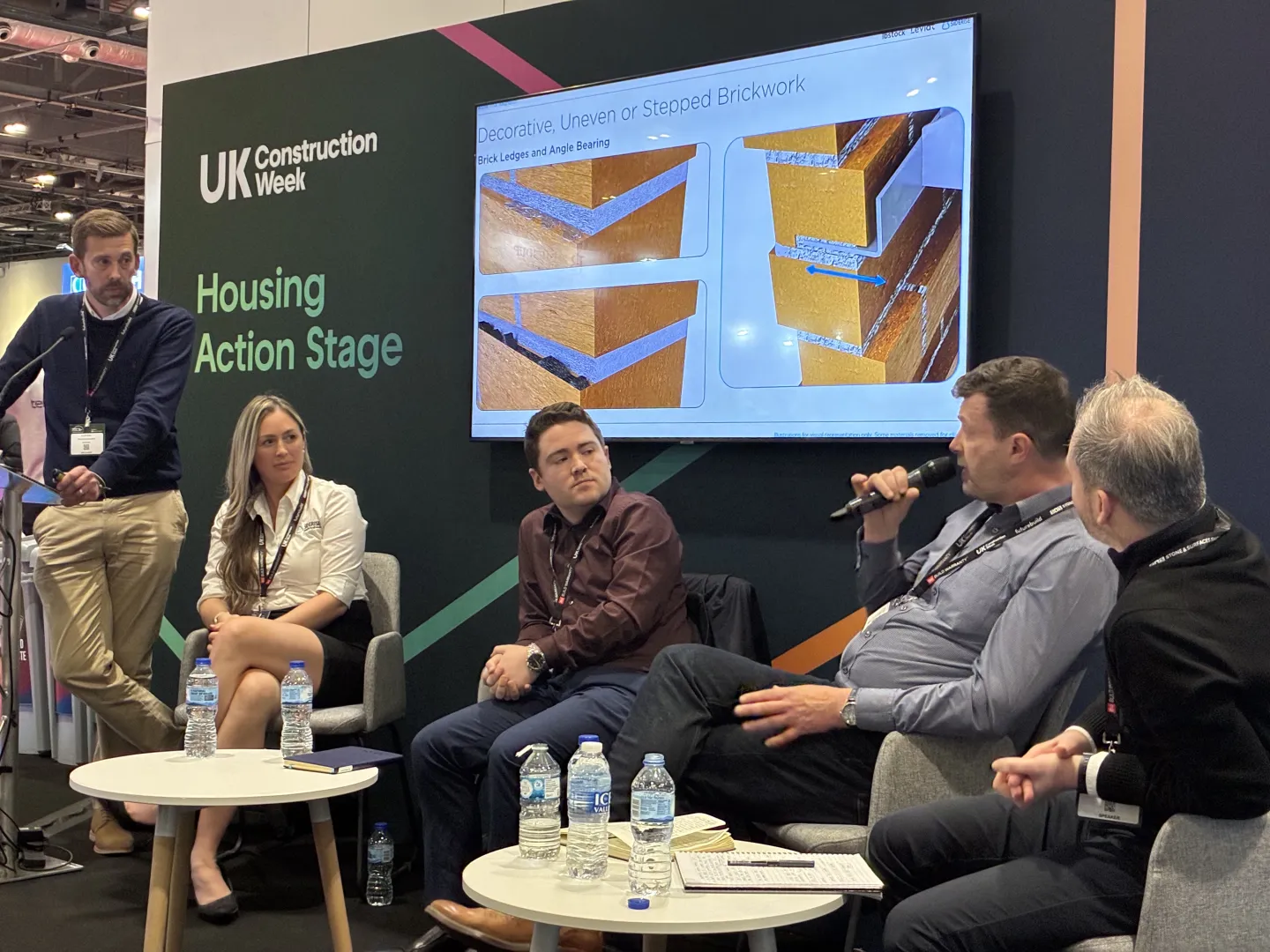
A highlight from UKCW was our participation in the panel ‘Inside the Wall: Delivering Safe, Compliant Masonry Façades for High-Rise Housing.’
In collaboration with Leviat and Ibstock, this session explored the wall not as a series of individual products, but as a fully integrated system from structural elements through to passive fire protection and moisture management.
This ‘through-the-wall’ perspective is critical. In practice, performance is rarely determined by a single element. It is most often defined at junction interfaces: where systems meet, complexity increases, and risk accumulates.
The panel reinforced a simple but important principle: when we design in silos, we create gaps; when we design as systems, we reduce them.
Across both our panel and wider discussions at UKCW, one theme came through consistently: the earlier collaboration happens on a project, the better the outcome.
The challenges the industry faces today in terms of compliance with the Building Safety Act, increasing scrutiny on product performance, and more complex façade typologies are difficult to resolve late in the process. They must be addressed at the point of design intent. A more integrated approach supports:
Clearer detailing, reducing ambiguity at interfaces.
Fewer clashes onsite, improving buildability.
Better alignment between design, specification and installation.
Greater confidence in performance across the building lifecycle.
This is not just best practice, it is fundamental to delivering safe, compliant and high-performing façades.
Beyond specification: communication in the age of AI
It was fantastic to see UKCW introduce the new Marketing and Procurement stage, offering a dedicated space for these crucial disciplines to discuss their journeys and influence in the built environment.
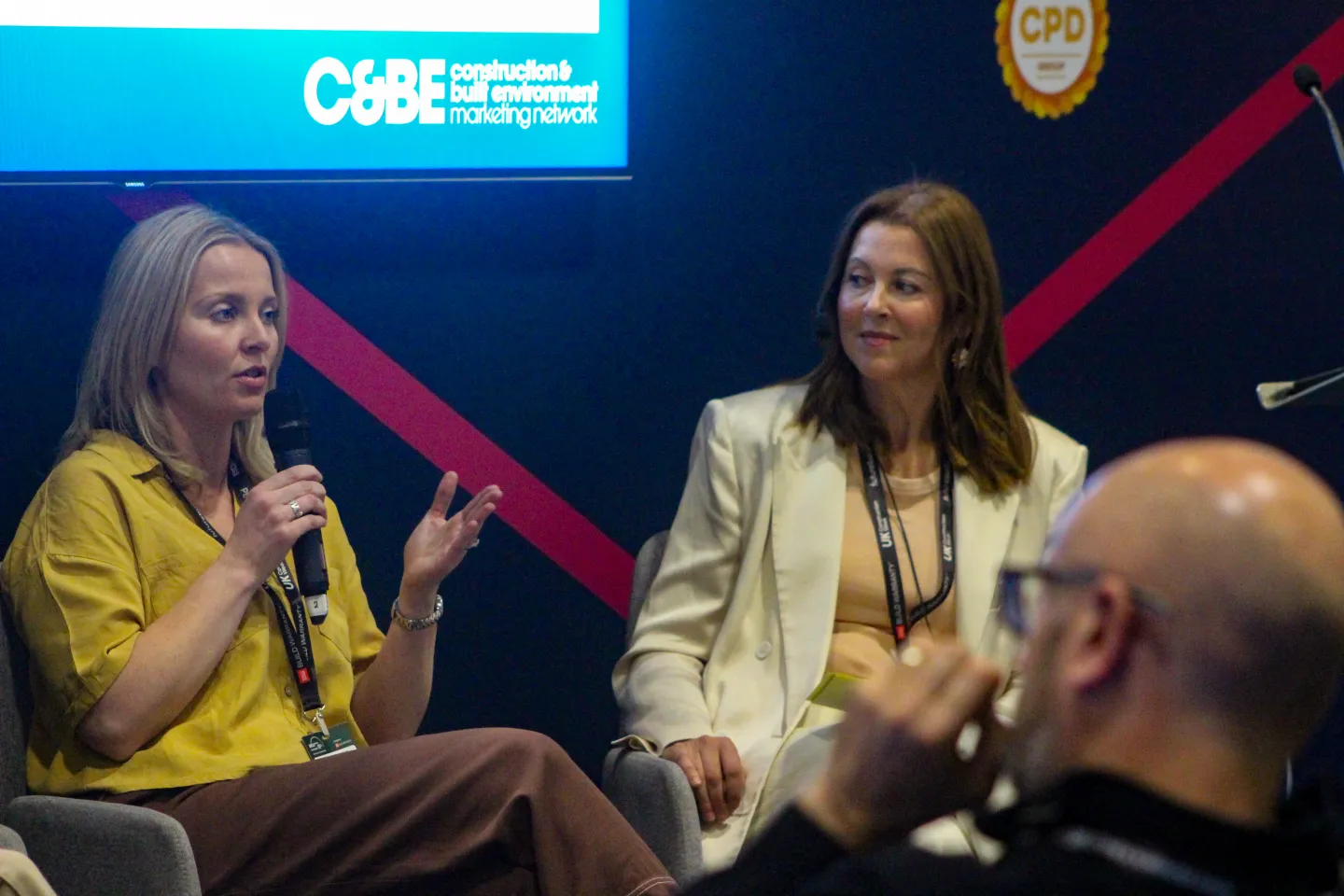
Our Marketing Director, Penny Howell-Jones, proudly partook in a panel at the inaugural Marketing stage, for a discussion on ’AI, search and zero-click: what is keeping marketers awake at night?’
This Marketing-led discourse a saw UKCW highlight a shift in how construction organisations communicate - by exploring the intersection of brand, demand and artificial intelligence.
These themes align with wider industry insight from SLG Marketing’s Horizon 2026 Report, which points to a sector navigating increasing complexity in both how products are specified - and how they are understood.
The construction buying journey is no longer linear. Decisions are shaped earlier, often across multi-disciplinary teams with different priorities and levels of technical understanding. This means influence increasingly happens before direct engagement.
At the same time, the role of brand is evolving. It is no longer simply about visibility, but about trust - particularly where technical solutions appear similar. In this context, brand becomes the accumulation of:
Technical expertise.
Consistency and clarity of information.
Proven application through real-world case studies.
Ongoing meaningful and reliable support across the project lifecycle.
Artificial intelligence is accelerating this shift. As digital discovery evolves, technical content is no longer simply searched, it is interpreted, summarised and compared across sources.
For manufacturers, this raises the bar. Intensified by the government’s current construction products reform affecting product information, content not only has to be technically accurate and unambiguous, but it must also be consistent across platforms and touchpoints, and structured to support interpretation. At a time, which sees a serious overlap of rapid AI adoption vs. AI accuracy, it is fair to say that unclear or inconsistent information introduces more risk than ever.
Kate Perrin, Marketing Director of Barbour ABI said:
"Attending UKCW/Futurebuild last week was rewarding, especially with the marketing agenda finally being placed front and centre where it belongs.
A personal highlight was chairing a panel of marketing leaders, including Penny Howell-Jones from Siderise. Together we dove deep into the world of AI and tackled the burning questions of what is currently keeping constrction marketers awake at night. It’s clear that our industry is at a massive turning point, and marketing is poised to lead the charge."
Looking ahead: connection as a defining principle
If there is a single takeaway for us from UK Construction Week 2026, it is that connection is now a defining principle of construction performance.
Connection between disciplines to reduce risk.
Connection between systems to ensure performance in practice.
Connection between people and information to support competent decision making
For Siderise, this fuels our mission to ‘Go Beyond, contributing to safer buildings’. We are dedicated to supporting the construction industry with unparalleled technical insight, collaboration across the entire project lifecycle and a system-led approach to deliver safer, more robust buildings.
Contact us
We're here to help you
Call for our main switchboard
Email us for technical enquiries
Email us for site support
Complete the form for the right response