Why are cavity fire barriers crucial to the long-term performance and safety of rainscreen façades?
Rainscreen façade systems are a popular choice for building exteriors in many parts of the world, thanks to their energy efficiency benefits and wide aesthetic possibilities. However, with these benefits the air gap between the inner and outer finishes of these ‘double wall’ constructions can present a very serious risk of rapid fire spread via the chimney effect, along with a risk of condensation, corrosion and mould growth through moisture accumulation if not carefully considered.
What is a rainscreen façade system?
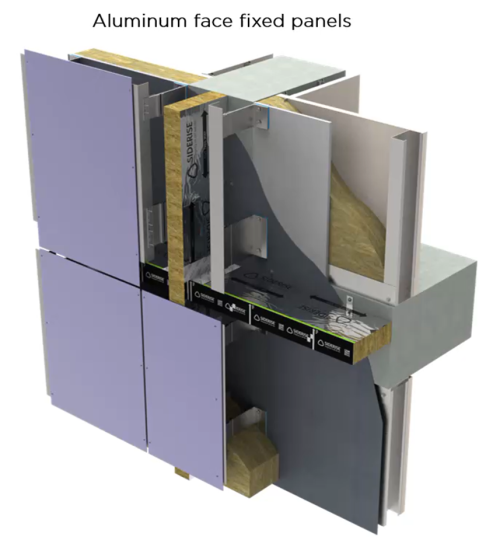
Rainscreen systems are a ‘built-up wall construction’, either drained and ventilated or non-ventilated, and typically consist of:
A backing wall or an inner concrete structural element.
An insulation layer.
Waterproofing layers.
Brackets.
The external cladding / exterior wall covering finish, e.g. aluminium cassette panels, brick slips.
Separating the inner wall from the outer skin is an air gap or cavity. Depending on the moisture management mechanism, in ventilated systems this space is in effect an open channel that runs vertically up the façade. It allows any moisture that enters the system to effectively drain away through gravity or evaporate through air circulation (drained and back ventilated (DBV) rainscreen), or limits water from penetrating in the first place by balancing the interior air pressure with that of the exterior (pressure-equalised (PER) rainscreen). In non-ventilated systems, which may be preferred for low-rise buildings in dry climate zones with little rainfall and humidity, the cavity is sealed so air does not circulate. We will focus on ventilated systems.
Due to the air pressure differential between the top and bottom of the cavity, this gap allows a continuous cycle of air to flow through the cavity. This helps to cool down the exterior of the building, supporting comfortable temperatures indoors without over-reliance on potentially costly mechanical air conditioning — making them a sensible choice for projects aiming for lower operational costs and higher sustainability credentials.

How can we prevent fire spreading through rainscreen systems?
In the event of a fire entering the external wall construction, this cavity can pose a real challenge to the building’s fire safety as it draws the heat, smoke and flames up the building, affecting multiple floors and putting lives at risk. Even the smallest fire within the cavity can quickly become ferocious as the confined space means any radiant heat is trapped and can only travel upwards, creating a hotter fire that can easily spread.
To prevent this ‘chimney effect’, it is crucial that the cavity within a rainscreen system is closed off using cavity barriers or fireblocks — a mass of fire-resistant material, that seals the cavity in strategic locations, such as at junctions between walls and floors, and around doors and windows to provide fire separation within the cavity by subdividing it into smaller voids, and closing concealed spaces and cavity edges to prevent the penetration of smoke or flame and restrict the movement of fire within. This prevents extensive fire spread, allowing occupants enough time to escape, fire and rescues services to carry out their operations, and limiting property and asset damage.
What are the rainscreen cavity fire barrier options?
Standard cavity fire barriers are ‘full fill’ or ‘closed state’ products, meaning they are fitted directly between the internal and external layers to completely seal the cavity. This makes them ideal for vertical applications as they can help maintain the air pressure within compartments, preventing the fire from spreading horizontally around the building.
However, full-fill cavity fire barriers are not suited to horizontal applications in ventilated rainscreen façade systems as this would prevent moisture in the system from effectively draining or evaporating away resulting in condensation forming within the cavity. This would lead to moisture build-up on the cavity barrier and damp within the building envelope.
To resolve this issue, ‘open state’ cavity barriers (OSCBs) were developed. These fire barriers include an integral intumescent material that rapidly expands in reaction to high heat (around 130°C / 266°F). This allows them to be fixed to the internal wall, leaving the ventilation gap open to allow for moisture drainage and the free-flowing movement of air for ventilation day-to-day (sometimes referred to as the ‘cold state’). However, in the event of a fire, the intumescent expands in a matter of seconds until the void is fully closed and a robust fire seal is formed.
How do I choose the right cavity fire barrier for rainscreen?
Both testing and real-world fires demonstrate that cavity barriers can make a significant contribution to the overall passive fire safety of a building, whilst selecting cladding and cavity barrier systems that are appropriate for the climate conditions can help avert moisture related issues. The following are all factors to consider when selecting cavity barriers.
Testing
To specify them correctly, it is important to understand what fire test standards to look out for. Standard full-fill cavity barriers can be tested to EN 1366-4 Fire resistance tests for service installations - Part 4: Linear joint seals. This standard determines the fire resistance of linear joint seals. It tests both horizontal and vertical applications and allows some movement in one direction before the test starts.
The Association for Specialist Fire Protection (ASFP) Technical Guidance Document TGD 193 and the recently published European standard EN 1364-6: 2025 standard both outline test configurations and failure criteria for the testing of OSCBs. These tests are based on the existing EN 1366-4 linear joint seal test (using the principles of EN 1363-1) with some modifications, including allowing five minutes for the intumescent to close the gap.
Whilst these tests can determine standalone cavity barrier performance and therefore general suitability for the purpose it is marketed for, it is only through large-scale testing that we can fully understand how complete assemblies perform in their intended application and how they might perform in a real-life fire scenario. Large-scale testing examines all the system components together, providing data on how the different products interact, along with the impact of details such as joints, gaps, and penetrations on the overall fire performance. Therefore, data from large-scale systems tests such as BS 8414-1 &2 and NFPA 285 that evaluate the performance of a complete façade assembly can be invaluable when considering cavity barriers.
It is important to note that, even with the inclusion of cavity fire barriers, rainscreen systems can fail if the external cladding allows the fire to spread up the outside of the building causing the panels to move, break down or come away. Any malfunction with the cladding would likely leave a path for the flames to spread up and over the cavity barrier and into the cavity. Therefore, it is vital to always refer to the latest specialist advice for façade design and specification, and to ensure high quality workmanship at every stage.
Third-party certification
Third-party certification is essential for ensuring products are fit for purpose and should form an important part of the design and procurement process. Whilst not always compulsory, third-party certification along with testing to the correct standards, are the best ways of assessing and verifying product performance.
Design life
Because barriers are located in the wet zone, they must be resistant to moisture. They must also be durable enough to accommodate in-service movement to maintain their form and performance throughout their designed life.
Durability and resilience can be determined through accelerated age testing in accordance with EOTA (European Organisation for Technical Assessment) Technical Report 024. There are 5 levels of assessment with Type X being the most onerous category covering weather exposure to rain, UV, high temperatures in summer, frost, and frost-thaw in winter.
The design life of different products should be checked with the manufacturer to determine if they meet, exceed or fall short of the building’s design life since a barrier with a 25-year design life may not be suitable for a building with a 60-year design life.
Cavity barrier retention
Poorly retained barriers risk being rendered ineffective as a fire barrier and can also possibly block drainage. They must therefore be retained to the substrate securely using suitable fixings, and without support from the envelope. Brackets that penetrate the full thickness of the barrier with the tails bent over to positively retain the barrier in position are considered a more robust retention method.
Learn more about this topic in this insights blog 'Why is positive mechanical retention key to the performance of open state cavity fire barriers?'
What are the Siderise solutions for rainscreen applications?
External cladding façade systems bring both a wealth of creative potential and clear thermal efficiency benefits to all kinds of buildings. Ensuring that they include cavity barriers that have not only been appropriately specified for the type of system they will be installed in but that have performance is backed by testing that reflects their end use can help to protect our built environment for generations to come.
At Siderise, we offer a suite of passive fire protection solutions specifically developed and tested to meet the demands of a wide range of rainscreen applications. We have also created a handy Specification Pack which provides live links to everything you need to select the right solutions for your rainscreen project, from technical data to design support.
If you want to dive deeper into this topic, do our RIBA credited CPD module in your own time on our online learning portal or request an in person seminar: [email protected].
Contact us
We're here to help you
Call for our main switchboard
Email us for technical enquiries
Email us for site support
Complete the form for the right response