What is the difference between one-part and two-part
firestopping systems for curtain walls?
Fire safety in glazed façade systems is a critical consideration—particularly in multistorey commercial and residential buildings. At the slab edge, firestopping plays a vital role in maintaining the integrity of the compartment floor by extending its fire resistance to the façade rear, helping to prevent fire from spreading vertically between storeys and supporting compliance with various fire and building codes and regulations.
In this insights piece, we explain the performance differences between one-part and two-part perimeter joint firestopping systems to help project teams assess the most suitable option for curtain wall applications
There are two types of curtain wall perimeter fire barrier solutions commonly available on the market. They can be broadly categorised into one-part dry-fit firestop systems and two-part safing-and-sealant firestop systems (also known as two-part pack-and-spray systems). While both approaches can achieve regulation and code compliance, the choice of system can significantly influence factors such as fire resistance and durability, installation speed and accuracy, long-term resilience, and ease of inspection and repeatability—making product choice a strategic decision on all kinds of projects.
What are one-part and two-part firestops?
Two-part pack-and-spray systems
Traditional approaches to firestopping at the façade / floor slab interface require the installation to be carried out in two separate stages:
Manually compressing generic mineral wool firesafing insulation (typically at 25% or 33% compression depending listing requirements) before installing it within the movement gap at the perimeter construction joint.
Applying a wet sealant such as a spray-applied fire-rated silicone or elastomer over the top of the safing to create a moisture resistant smoke barrier once cured.
NB It is important to note that whilst the terms firesafing and firestopping are sometimes used interchangeably, they do mean two very different things. In this context, firesafing is where a fire-resistant material is used to fill the void to insulate against heat transfer and prevent fire spread but does not have a fire-resistance rating for the designated application in and of itself i.e. it is one component of a firestop system, and it is the assembly that is fire rated - hence the description ‘two-part’.
Firestopping is where a material or combination thereof is used to continue the fire resistance of the floor slab and act as a barrier to the passage of flames and hot gases between compartments.
One-part dry-fit systems
One-part dry-fit systems, such as the Siderise CW-FS Firestop, feature factory-engineered stone wool Lamella insulation with foil facings applied to the cut surfaces of pre-compressed vertically oriented fibres to retain the ‘built-in compression’ and assist with uniformity of product density. Designed and tested to provide a robust fire and smoke seal in the perimeter void between the façade and compartment floor, without the need for a topical wet sealant, they are installed in a single-fix with additional manual compression (usually 10% or 20% depending on test certification / listing compliance requirements) for a tight fit and to accommodate movement at the floor slab / curtain wall interface.
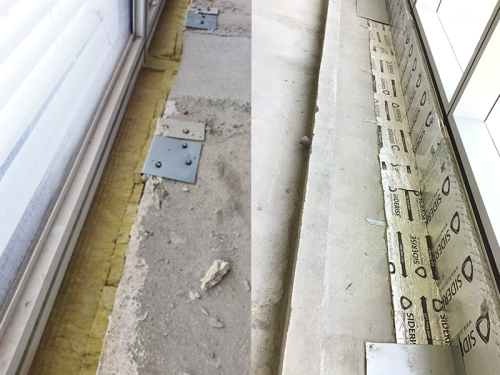
The Siderise one-part-dry fix system and the safing component of a two-part spray and pack system at the curtain wall / floor slab intersection.
What are the benefits of one-part dry-fit systems over two-part firestops?
Ease of specification
One-part dry-fit firestops can be ordered pre-cut to suit the cavity width and can be supplied as part of a complete system package from a single manufacturer with spandrel insulation, mullion and transom fire protection, plus ancillary components. These products are often tested together in multiple test scenarios, and third-party certified as a perimeter fire containment system for effective passive fire protection in the spandrel zone.
Two-part wet-seal systems require a firesafing material and an appropriate sealant to be specified. To comply with the criteria of any third-party approvals or listings published by the sealant manufacturer, the safing insulation product should always be the same as that used in the certified tested system. Using substitution products risks undermining the specified fire resistance performance of the complete firestopping assembly, resulting in non-compliance.
Resilience, durability and fire performance
As we explore in this Insights blog, firestops installed within curtain walling systems must be durable enough to maintain their form and fit, even when subjected to façade and floor slab movement. The safing insulation component of two-part firestop systems typically comprises standard mineral wool insulation with horizontally oriented fibres. Most certification listings call for cut sections to be rotated 90° by the installation operative to reorient the fibres so that they run vertical to the floor slab when installed. If this does not take place, the fibres will run parallel and while this transverse alignment offers stability, continual exposure to building / façade movement makes the material more susceptible to degradation along its length, resulting in the fibre structure breaking down. This means that the ability of the safing material to recover from repeated compression cycles in-service is reduced.
This can lead to the firesafing no longer maintaining the compression fit, increasing the risk of a gap forming between the product and the façade over time. Should this occur, the perimeter seal could fail prematurely, resulting in loss of compartmentation.
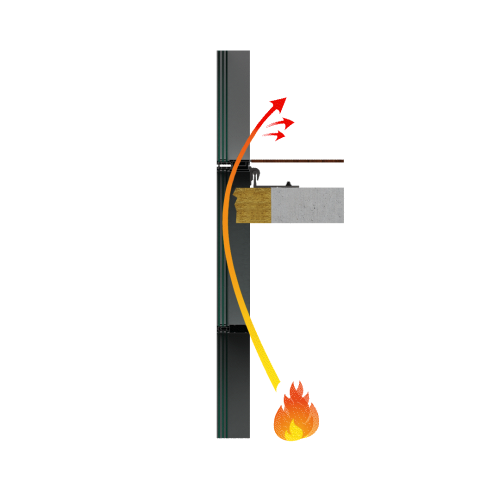
Gaps will form between the curtain wall and the firestop if the safing material is unable to withstand stresses and strains from building and facade movement.
Meanwhile, one-part firestops with a stone wool Lamella composition comprise vertically oriented fibres that run parallel to the substrate when installed. Products with a vertical fibre orientation are highly compressible and flexible laterally (across their width), which enables them to not only overcome challenges presented by curved and inclined façades much more easily, but accommodate the dynamic movement of the curtain wall or floor slab for their designed life.
Due to their unique structure, Lamella firestops maintain their ability to recover throughout their design life, as demonstrated through extensive age and movement cycling testing. This means that the seal is continuously maintained throughout the lifetime of the building and for the required fire resistance period in the event of a fire. When exposed to fire, the foil facing is designed to delaminate from the stone wool Lamella core, allowing the built-in compression to be released. This enables the product to expand and maintain its compression fit and integrity, even under the greater thermal stresses caused by the fire load that leads to facade and floor slab deflection.
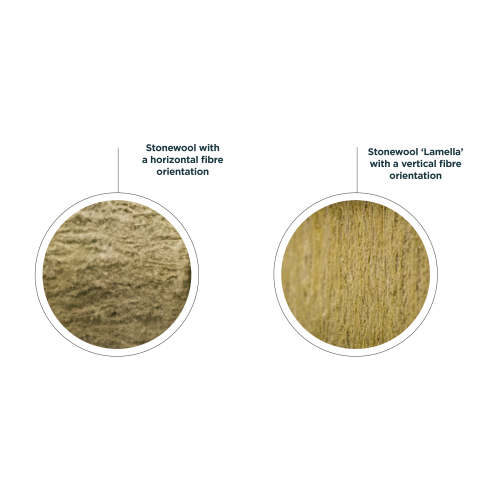
Safing with a horizontal fibre orientation is resistant to lateral compression, whilst products with a vertical fibre orientation are highly compressible.
Both system types can be tested to UL 2079 for air leakage, determined as the L-rating, to simulate smoke movement through compartmentation in buildings. Leakage testing can assist authorities in determining the suitability of firestopping systems for the protection of floor openings and smoke barriers for the purpose of restricting the movement of smoke in accordance with the NFPA (National Fire Protection Association) 101 Life Safety Code.
The difference between two-part spray and pack systems and one-part dry-fit systems is that the latter does not rely on a wet seal to provide an adequate L rating.
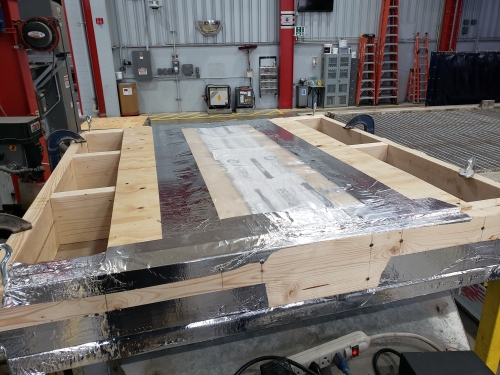
UL 2079 tests for air leakage to simulate smoke movement through compartmentation in buildings.
Application and storage conditions
During storage, application and curing, the wet seal compound in two-part perimeter barrier systems is temperature-dependent and moisture-sensitive. This can be a challenge during hot seasons or locations with frequent rainfall — otherwise adhesion, curing, design life and product integrity may be adversely affected. In most cases, the maximum application temperature is typically limited to 40°C (104°F) as high heat can cause rapid skinning or premature curing, making tooling difficult and reducing adhesion. They also must be stored between 5 and 25°C (40 and 80°F), which can require onsite storage facilities with a controlled environment, particularly in regions prone to inclement weather. Improper storage can reduce workability if the sealant has thickened, shorten open time and curing consistency, and compromise the fire rating performance due to chemical degradation.
Two-part dry-fix systems simply require a dry and clean surface to fix them to and can be stored onsite in a general sheltered area to prevent rainwater damage.
Installation process
A common installation error with the safing component of two-part systems is the material not being rotated so that the fibres sit perpendicular to the slab edge before being installed, which, as mentioned earlier, negatively impacts durability thus performance.
Before installing the smoke barrier of two-part wet-seal systems, surfaces must be prepared with extra care to allow adequate bonding and even curing. The wet compound must then be applied with a consistent thickness, in line with system testing as any variations in thickness that fail to meet the specified tested system design risks rendering it non-compliant. Transporting and setting up heavy spray rigs, with specialist equipment such as pumps and mixers, can be time-consuming as can labour intensive manual methods such as portable hand sprays or application by hand, while tight slab-edge zones often lack room for bulky equipment.
In addition to having to wait for the right application conditions, the ‘curing’ and messy overspray clean up time needs to be accounted for in the project schedule. This installer-driven and weather-dependent approach can also make it challenging to achieve a replicable and verifiable level of quality across whole buildings of multiple storeys, creating bottlenecks.
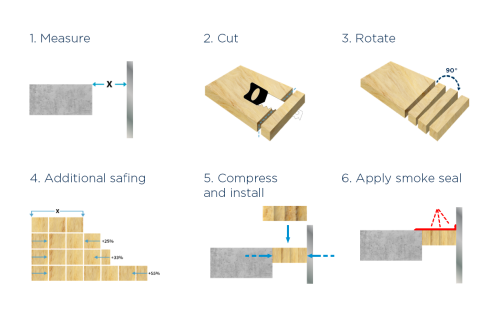
Typical installation process for two-part safing-sealant systems
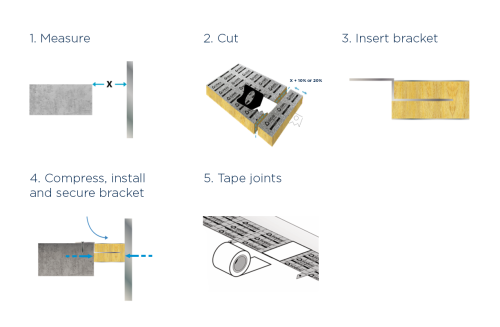
Typical installation process for one-part dry-fix perimeter firestopping systems
In contrast, one-part dry-fit firestops are not as weather or temperature-sensitive and do not require any specialist application equipment or highly intensive surface preparation of the substrate. There are no curing times, wet or dry-film thickness complications. Their straightforward installation approach, including a standardised compression percentage, can streamline the installation process and help reduce the risk of human error. They also provide greater freedom for the installer in areas where access to the firestop zone is difficult after the façade is installed. Dry-fit firestops can also be installed before the façade (including from the soffit).
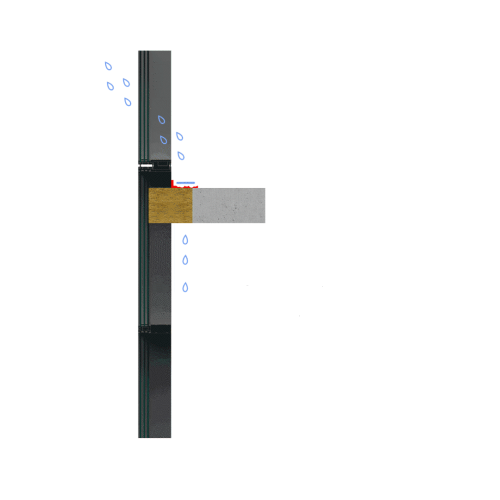
Joints exposed to water during the installation phase of wet-applied smoke seals can result in ‘washout’.
Inspection
With two-part systems, once the wet seal is applied, verifying the correct dry-film thickness, adhesion, and safing orientation and compression ratio becomes impossible without destructive testing or a two-stage inspection, which means site operatives cannot immediately proceed with adjacent works, thus potentially holding up the build program.
Alternatively, when dry-fit, one-part firestops are installed, visual inspections are generally sufficient. The wrinkling of the foil makes it very easy to confirm if they have been installed under compression without disturbing the installation. Their dry-fit application also makes it easier to judge bracket locations and distances, and tight jointing to ensure a continuation of the fire performance around the perimeter.
A modern approach to protecting curtain walls
While traditional two-part firestop systems have been widely used all over the world, they often present challenges related to long-term durability, installation complexity, and inspection consistency. In contrast, one-part firestop systems that have been engineered and tested to key standards such as EN 1364-4, EN-1364-3 and ASTM E2307 offer a reliable alternative. By delivering uniform compression, accommodating façade movement, and enabling straightforward visual inspection, one-part dry-fit systems support code-compliant construction practices and help ensure consistent fire-resistance performance across every floor and project.
Discover more about our one-part dry-fit Siderise CW-FS Firestop.
Contact us
We're here to help you
Call for our main switchboard
Email us for technical enquiries
Email us for site support
Complete the form for the right response